Jackal-Headed Alien Plans to Break Free from Prison: PYRAMIDS OF MARS
- Benedict Jackson
- 5 days ago
- 7 min read
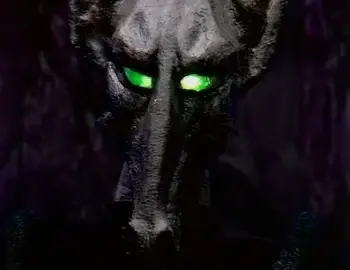
When an archaeologist unearths an ancient tomb in Egypt, little does he realise the danger that lies inside. Soon, Sutekh the last of the Osirans is putting a plan in place to break free from his internal imprisonment to wreak havoc on the universe once more. With the aid of his robotic mummies and the undead Marcus Scarman, the Earth will be forfeit if Sutekh succeeds.

Cast
Tom Baker (Doctor Who), Elisabeth Sladen (Sarah Jane Smith), Bernard Archard (Marcus Scarman)
Michael Sheard (Laurence Scarman), Peter Copley (Dr Warlock), Peter Mayock (Namin), Gabriel Woolf (Sutekh)
Michael Bilton (Collins), Vik Taliban (Ahmed), George Tovey (Ernie Clements)
Nick Burnell, Melvyn Bedford, Kevin Selway (Mummies)
UNCREDITED CAST: Tony Alless, Oscar Charles (Egyptian Labourers)
Gabriel Woolf (Horus [voice])
Crew
Stephen Harris (Writer), George Gallaccio (Production Unit Manager), Peter Grimwade (Production Assistant)
Title Music by Ron Grainer & BBC Radiophonic Workshop, Bernard Lodge (Title Sequence)
Dudley Simpson (Incidental Music), Dick Mills (Special Sound), Barbara Kidd (Costume Designer)
Jean Steward (Make-Up), Ian Scoones (Visual Effects Designer), Ron Koplick (Studio Lighting)
Brian Hiles (Studio Sound), John McGlashan (Film Cameraman), Andrew Boulton (Film Sound)
MAC Adams (Film Editor), Robert Holmes (Script Editor), Christine Ruscoe (Designer)
Philip Hinchcliffe (Producer), Paddy Russell (Director)
UNCREDITED CREW: John Hills-Harrop (Assistant Film Sound Recordist), Sid Marker (Grips)
Ian Brindle (Film Ops Manager), Val Hodgkinson (Director's Assistant (Location)
Kevin Rowley (Assistant Film Cameraman), Phyllis Page (Booking Assistant), Nanis Davies (Contracts Assistant), Ron Brown (Sound Recordist), Nigel Meakin (Camera Assistant), Des Stewart (Armourer)
Carolyn Greaves, M. Wade (Make-Up Assistants)
Harry Bradley (Technical Manager) Dave Jervis (Inlay Opertor), Janet Radenkovic (Prodution Unit Manager)
James Gould (Vision Mixer), Judith Long (Design Assistant)
Caroline Rogers (Director's Assistant (Studio)
Colin Reid (Senior Cameraman), Ray Ingram (Costume Assistant)
Paul Braithwaite (Assistant Floor Manager), James Burge (Floor Assistant)
Broadcast
EPISODE | DATE | TIME | RATING | CHART POSITION | APPREICARTION INDEX |
1 | 25/10/1975 | 5:45-6:10pm | 10.5M | 28th | - |
2 | 01/11/1975 | 5:45-6:10pm | 11.3M | 15th | - |
3 | 08/11/1975 | 5:45-6:10pm | 9.4M | 37th | - |
4 | 15/11/1975 | 5:45-6:10pm | 11.7M | 22nd | 60 |
Connections in the Who-Niverse
Bernard Archer was previously Bragen in The Power of the Daleks and he was considered for another nine roles - which he didn't get in the Doctor Who universe. Michael Sheard was a six-time Who veteran: he was Rhos in The Ark, Dr. Summers in The Mind of Evil, Lowe in The Invisible Enemy, Mergrave in Castrovalva and lastly the Headmaster in Remembrance of the Daleks. Peter Maycock returned as Solis for The Deadly Assassin. Michael Bilton was the French Councilor, Charles de Teligny for The Massacre and he too returned for The Deadly Assassin playing a Time Lord. Mervyn Bedford was Reig for Planet of Evil. Gabriel Woolf returned to the show to voice The Beast for The Impossible Planet/The Satan Pit and reprised his role as Sutekh in 2023.
Death the Constant Companion
Every character is killed, a very rare occurrance in the history of Doctor Who. Dr. Warlock is killed by one of the Mummies under the orders of Marcus Scarman (under the influence of Sutekh). Namin is murdered by the 'servant' of Sutekh (Marcus Scarman), Namin dies a slow and painful death. Collins, the poor elderly butler is also murdered by a Osiran Service Robot, strangled to death in a matter of seconds. The poacher Ernie Clements (poachers and game keepers have had similar bad luck) is crushed to death between two Osirian Services Robots. Fun Fact: he was supposed to die, but Paddy Russell cancelled those plans. Laurence Scarman is murdered by own brother. Marcus Scarman himself is freed from Sutekh's control, but is promptly killed when his usefulness dried up. Sutekh is supposedly killed when he is thrown into the time vortex, thousands and thousands of years in the future; but.... The only people to make it out are Ahmed seen in part one and the two Egyptian Labourers who flee with Ahmed. Who thought running away from your problems would be a good thing here.
Episode Cliffhangers
(1) The sarcophagus turns into a vortex tunnel and a black, hooded figure emerges. The figure pronounces himself as the servant of Sutekh, and no other is required. The figure grabs hold of Namin, who is killed by Sutekh’s gift of death
(2) The Doctor activates the Marconiscope which will block Sutekh’s control over Marcus; but the process will kill him. Laurence attempts to stop the process, as his cottage is overrun with Mummies. One of them reaches out to strangle Sarah to death.

(3) The Doctor travels to Sutekh’s tomb in Egypt to break his concentration from the missiles being built by Scarman and his Mummies. Sutekh is distracted by The Doctor’s presence, and the missile is destroyed. Sutekh blasts The Doctor with energy from his eyes, and The Doctor is flung onto a wall and winces in pain.
(4) Sutekh has been thrown into the far future and seemingly dies from old age. The priory catches fire, and The Doctor and Sarah make a quick getaway in the TARDIS, as the fire spreads all around the priory.
Fun Facts
(1) It was script editor Robert Holmes who pushed to feature a story written by Lewis Griefer, to feature in the show's history. Griefer had an interest in Egyptology and developed a storyline. However, the storyline was too complex and was continually rewritten and rewritten. Eventually Griefer became too ill to carry out other rewrites, and the scripts were heavily amended by Robert Holmes; (2) An idea pitched by producer Barry Letts didn't make it into the final programme. Letts suggested that the Ancient Gods of Egypt came from a Galactic Federation which had visited Earth centuries prior; (3) For a while the story was set at the British Museum and featured a fortune-seeker called Hennessy and another character called Professor Fawzi. A Guard character would have fallen victim to a Mummy; (4) Costume designer Barbara Kidd realised that the production would have to cheat

and break the conventional look of Mummies. Mummies always had their legs bound together; but the production required the Mummies to walk about the place, so the legs had to be erect; (5) The actors who played the Mummies were all fresh out of drama school: the Guildhall Drama School. Two veteran Doctor Who extras: Dave Carter and Philip Ryan were also considered for the parts; (6) Overall the serial would feature one of the smallest cast ensembles in the show's history, exclduing the two extras who appeared in part one. They were both supplied by Oriental Casting Agency; (7) It was hoped the Martian rocket could be detonated and destroyed on location, but because Stargroves Manor was a listed building this wasn't possible; (8) Sutekh's jackal-head was built by long-standing visual effects assistant and sculptor John Friedlandeer, but it was too small for Gabriel Woolf to wear. In such instance, the mask was placed on a dummy Sutekh; (9) Ernie Clements was originally going to survive, but director Paddy Russell could not find a legit reason for him to do so. So he was killed off during part two; (10) The fire seen at the end of part four was reportedly the biggest fire created at Television Centre Studios at the time.
Recording Days

Recording was complete over 13 days between 29 April - 3 June 1975. An extensive four-day shoot was carried out at Stargroves Manor (then owned by Mick Jagger). The shoot utilised the surrounding woods and courtyside and the grounds which provided all necessary location scenes written for parts one, two and three. Due to the building being listed, certain scenes involving explosion all had to be captured at the Puppet Theatre at Television Centre. Three day of model filming were carried out at the Television Centre Puppet Theatre between 7 - 9 May whilst two more days were carried out between 22 - 23 May. All model shots involving the TARDIS were captured during this time, including a shot of ravaged, 1980s Earth which ended up on the cutting room floor.
Studio recordings were complete on Monday and Tuesday evenings in Television Centre Studios 3 and 6. All studio scenes were complete on 19 - 20 May and 2 - 3 June.

Verdict
You don't understand the implications. I'm not a human being. I walk in eternity.’ Doctor Who has been things since its inception and everyone also has their preferred era. When anyone asks what era or stories [they] should check out, there is always a different answer. However, there is always a handful of stories that is always on people’s radar dish, there are a handful of stories that people always comes back to, there are stories which stand the sands and tests of time, Pyramids of Mars is one of those stories. This is one of the most beloved and memorable stories of the 1970s, and quite rightly so, this is simply of the best Doctor Who of all time.
Illogical and nonsensical plot threads aside this is tightly written as the plot moves from one plot point to next. The plot progression is both natural and well-plotted, with no sudden jumps in pace or action, its knows how to hype the tension and create an atmospheric period piece with gorgeous production and design work, well

handled visual effects and some memorable death scenes, this is a tight production from every angle. The scripts also have to juggle elements of mythology and science fiction, which make a much welcomed return to the show after a few years in absence, plus a little trip to the ravaged 1980 Earth (one of the best scenes in the show’s history, devasting and fascinating the same time). This might just be the best instalment from Paddy Russell (one of the show’s most assured and talented directors), she knows who to create suspense and downright horror and terror. The plot also makes great use of a small band of secondary characters who are unfortunately outshined by the ‘power’ of Sutekh. A superb villain brought to life by voice alone, he is a great villain. Woolf provides this subtle, almost straight, restraint performance; this is what makes a great villain memorable in the minds of viewers. This is masterclass example of the horror aesthetic background that shaped, refined, reformed and regenerated the show into a true adult-oriented show. This is more than an archetypical Doctor Who, this is Doctor Who at its finest and best. Only this show could take the walking corpse genre, add layers of flair and intelligence. This is must watch time and time again. *****
Independent, non-commercial Doctor Who review and analysis site. Not affiliated with the BBC. Images and media are used under fair dealing for commentary, criticism, review, parody, and analysis. All rights belong to their respective owners.


Comments